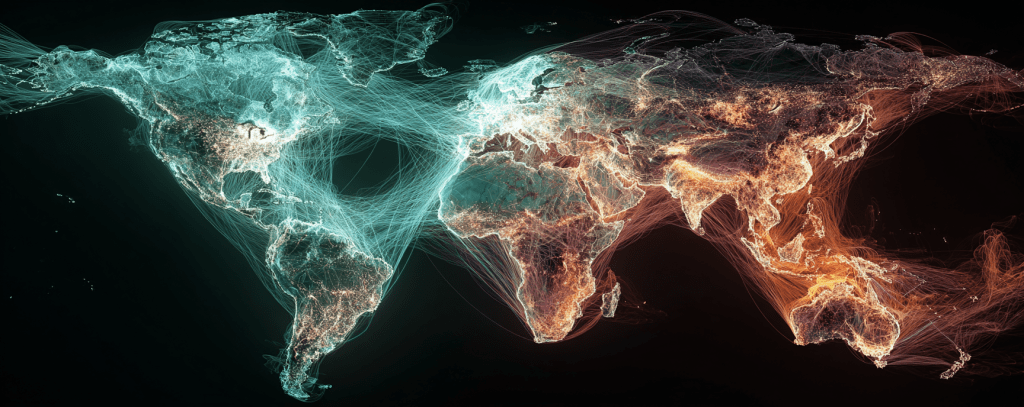
Every nation wants its citizens to live the longest, healthiest lives possible. Yet we’re watching the world fragment into isolated medical data and AI systems. With each potential AI trained on far less than 10%, it is inevitable that such AI will underperform a potential AI trained on all human human biological data. This matters because we’re dealing with human lives, if a narrow national medical AI achieves 90% cure rates instead of 95%, 5,000 additional people die for every 100,000 treated. Unlike navigation systems where a few meters of accuracy difference causes minor inconvenience, inferior medical AI causes preventable deaths at scale.
Given the strong need for human biological data at scale for training AI, there are equally important challenges to collecting and aggregating training data at scale, across nations that don’t necessarily trust each other and also have valid concerns for their citizen’s data security. At Biostate AI, our mission is to collect the world’s largest human multiomics data to train general purpose biomedical AI to understand and help treat all human disease, and I have personally spent a large amount of my time over the past 2 years to understand and invent solutions that allow global data collaboration at scale, in a game theoretic lens to enable a happy Nash equilibrium where 90% of the world’s population live to 90 years old, enough for other radical biological life extension technologies to take off.
Game Theory and the Sovereignty Paradox
The global positioning system (GPS) offers a revealing precedent for medical AI. The United States opened GPS in the 1980s, transforming aviation, shipping, agriculture, and daily life with near-universal access to precision navigation. Yet within two decades Russia had revived GLONASS, China launched BeiDou, and Europe financed Galileo—collectively spending more than $20 billion to duplicate a system already available for free, and committing billions more each year to keep those constellations aloft. These weren’t vanity projects. The lesson had been seared into national security planners by the Kargil War of 1999, when the United States denied GPS access to Indian forces, and again in Iraq, when Washington selectively degraded accuracy by region. Dependence on a foreign-controlled infrastructure, even one that worked flawlessly under normal conditions, was seen as an unacceptable vulnerability. The possibility of denial during crisis—no matter how rare—was enough to justify massive redundant investment.
The parallel to medical AI is direct, but the stakes are categorically higher. GPS accuracy differences are measured in meters: a tractor overlaps crop rows, a car parks on the wrong side of the building entrance. These are inconveniences, not existential risks. Medical AI accuracy differences are measured in mortality. A 5% gap in diagnostic or treatment accuracy is not a rounding error; it is the difference between life and death. If an isolated national system achieves 90% cure rates where a federated global system achieves 95%, that gap translates to hundreds of thousands of preventable deaths in a single country each year. Scaled globally, technological nationalism in medicine could condemn millions to die unnecessarily—not because cures were impossible, but because governments chose isolation over collaboration.
At Biostate we model the problem through game theory. Most commentators reach reflexively for the Prisoner’s Dilemma, where defection dominates and cooperation collapses. Medical AI fits a different structure: the Stag Hunt. When hunters act together, they can bring down the stag; when each chases rabbits alone, they settle for meager returns. Both outcomes are stable, but only one produces abundance. Once trust tips the group into stag-hunting, no individual has reason to defect. The challenge is reaching that equilibrium when mistrust still dominates.
Six blocs hold the world’s biomedical diversity: the Americas, China, India, the Muslim World, Africa, and the European Union—genetic variants, disease prevalence, diet, and environmental exposures that shape how illness manifests. Training AI on one bloc’s data yields progress; combining two yields substantially more; combining all four unlocks insights impossible in isolation. The gains are not linear, but the pattern is clear: diversity compounds. Against this stand sovereignty costs—the political and security price of letting foreign systems touch citizen health data. These costs are rarely technical; they are fears of espionage, bioweapons, competitive disadvantage, or simply loss of control. When sovereignty costs are trivial, cooperation dominates; when they are overwhelming, isolation is inevitable. The perilous zone is the middle, where both cooperation and defection are stable, and outcomes hinge on trust. That is where the world sits today.
History shows how such knife-edge equilibria can be nudged toward cooperation with the right institutions. The International Space Station bound former adversaries into joint engineering, with national modules retaining control yet functioning as a single system. The Human Genome Project began in rivalry—public consortia versus Celera—but merged into a collaborative infrastructure once the futility of duplication was clear. CERN demonstrates that even nations recently at war can build and run the world’s most complex machines together, provided the governance preserves local identity while enabling collective gain. The lesson is that structure matters: cooperation does not require altruism, only institutions that lower sovereignty costs until trust becomes the rational choice.
The Federation Solution
The way forward is not to wish sovereignty concerns away but to design in ways that meet their goals. At Biostate we reduce the sovereignty cost by structure rather than persuasion. Federated learning allows models to train on distributed datasets without moving raw patient records across borders. Data stays under national law; only mathematical weights cross boundaries. Nations preserve control while still contributing to a global intelligence.
Our subsidiaries make this real. In China, Baisheng operates under Chinese law, with Kindstar Global as partner. Samples never leave Chinese soil, yet the training improves the global model. In India, Bayosthiti integrates with Tata Memorial Hospital under the same principle. Each region keeps its data, but contributes to collective learning. These arrangements are not abstract. They create anchored commitments: once local hospitals re-tool workflows, retrain staff, and adapt infrastructure, abandoning the collaboration would mean years of disruption and billions in lost investment.
Institutional design also addresses the time-consistency problem. Governments change; alliances shift. By structuring each subsidiary so that local hospitals, research institutes, and investors hold majority ownership, we create domestic constituencies for continuity. Chinese institutions owning Baisheng, or Indian institutions owning Bayosthiti, have every reason to defend the partnership regardless of Washington or Beijing’s mood. Over time, path dependence reinforces stability. Each node develops unique expertise and datasets that cannot be recreated cheaply. Like a common language, once enough people adopt it, switching away is no longer realistic even if alternatives exist.
Creating the Performance Cliff
The surest way to overcome sovereignty concerns is not persuasion but performance. Once the gap between national and federated medical AI becomes too wide, isolation is no longer a viable option. Countries may still insist on sovereignty in principle, but in practice they will either participate directly or import the global model. No minister can defend inferior survival rates once the difference is visible.
History offers clear analogues. In semiconductors, many nations once pursued domestic self-sufficiency. By the 1980s Germany, France, and even the United States invested in national fabs to reduce strategic dependence. Yet as Taiwan’s TSMC and Korea’s Samsung achieved scale and technical lead, the performance gap became insurmountable. Today, even the wealthiest nations import chips despite the vulnerability it creates. The cliff was simply too steep: inferior domestic fabs were politically indefensible.
Medical AI will reach the same point. A nationally isolated system may still function, but if a federated model can predict rare disease onset years earlier, optimize drug combinations for genetic subgroups, and cut diagnostic error rates in half, the comparison is fatal. The local system does not need to break to become worthless; it only needs to lag too far behind. At that point the debate shifts from “whether to participate” to “how to participate”—through direct contribution to federated learning, or through licensing. Either path is preferable to political suicide by insisting on inferior care.
Medical Tourism as Natural Demonstration
The proof of the performance gap already exists. Medical tourism is a live experiment in how patients vote with their feet when outcomes diverge. Houston’s Texas Medical Center treats more than 30,000 international patients each year, including ministers and royals from the Gulf. These are not citizens of failed health systems. Saudi Arabia spends over 5% of GDP on healthcare, builds hospitals with the same MRI machines and surgical robots as Houston, and recruits staff from top international programs. Yet its elites still fly to Texas for cancer and cardiac care. The difference is not the hardware. It is the accumulated expertise and data diversity that produces superior outcomes.
For patients the lesson is visceral. A Kuwaiti with a rare genetic mutation may owe his recovery to cases first identified in Japan, drug-response data drawn from Brazil, and side-effect patterns mapped in Europe. That survival story becomes proof of principle: global diversity saves lives in ways no national system can. And because the travelers are not ordinary citizens but the wealthy and politically connected, the lesson carries home into policy. A minister whose spouse lives because of a globally trained model will not quietly accept nationalist arguments for inferior care.
Houston illustrates the pattern vividly because it is where I live and where Biostate’s Bio R&D team is based, but it is not unique. Memorial Sloan Kettering in New York and other leading centers draw the same international patients for the same reason: outcomes follow from data diversity and accumulated expertise, not the presence of an MRI machine. The point is not that one city holds the key, but that medical tourism everywhere already proves the argument. When globally trained systems deliver recoveries that nationally limited systems cannot, the evidence travels home in the most persuasive form possible—through the survival of ministers, business leaders, and their families.
The Immigrant Advantage in Building Trust
Biostate’s structure itself carries a signal. My co-founder Ashwin is Indian, I am Chinese-American, and together we represent a pairing that remains unusual in Silicon Valley. Indian and Chinese immigrants are common in U.S. technology, but they rarely partner with each other at the founder level. The default pattern is for each group to pair with white Americans, reflecting how venture networks are organized. That Ashwin and I built Biostate together shows not just that collaboration is possible across historic rivalries, but that we have already staked our careers on it. When we meet with government and commercial leaders in Riyadh or Seoul, our partnership itself demonstrates that old divides can be bridged.
Equally important, our backgrounds insulate us against the instinct toward data colonialism. Too many global health projects have followed the same pattern: samples flow outward to Western labs, results flow back in diluted form, and sovereignty is reduced to rhetoric. That approach is no longer acceptable. Having lived across cultures, we know firsthand why sovereignty must be honored, not just tolerated. The structures we are building — subsidiaries owned locally, data remaining under local law, federated learning rather than centralization — are designed to avoid repeating that extractive model.
Our immigrant experience also gives us practical range. We have had to recalibrate repeatedly, moving between Boston, Beijing, and Bengaluru, each with its own signals of respect and trust. It allows us to enter new environments without assuming American norms will carry the day. And because we recognize that trust rests not in rhetoric but in relationships, we rely on genuine connectors: the physician trained abroad who now directs a Gulf hospital, the scientist whose collaborations span Shanghai and Boston. Working with such people keeps us grounded, and it is through them that trust becomes durable.
Scientific Publication as Moral Leverage
Scientific publication creates leverage that no amount of lobbying can match. When a paper in Nature Medicine or The Lancet demonstrates that models trained on African, Asian, and European cohorts predict drug toxicity more accurately for patients everywhere, the evidence cannot be dismissed as marketing. It enters the scientific record, where policymakers and clinicians must reckon with it.
The crucial point is mutuality. If global training were only about improving outcomes for minorities, it could be framed as charity or dismissed as extraction. In reality, majority populations also suffer from isolation. Variants discovered in African cohorts explain adverse drug reactions in European patients; Asian pharmacogenomic patterns prevent toxicity in Latin America. The examples are familiar but powerful: BRCA1 mutations first identified in Ashkenazi Jews reshaped breast-cancer care worldwide; the CCR5-Δ32 mutation in Northern Europeans guided HIV therapeutics; sickle-cell insights from Africa transformed hematology for all. Biological knowledge, once uncovered, belongs to everyone because biology itself respects no borders.
Publication also provides the clearest way to avoid accusations of data colonialism. Too often, samples have left the Global South, been analyzed in the West, and returned as finished products with little credit to the source communities. Federated learning prevents that by keeping data under local law, while multi-author papers can distribute recognition and authorship across all participating countries. A pharmacogenomics study that includes investigators from Africa, Asia, Europe, and the Americas does more than strengthen the science — it creates a network of stakeholders who have shared ownership of the results and carry the case for collaboration back to their own institutions. The mechanism is simple: when credit is shared, collaboration becomes self-reinforcing.
This strategy also creates a categorical distinction between biomedical AI and the broader field of artificial intelligence. Language models inevitably raise questions of cultural bias, surveillance, and economic disruption. Biomedical AI instead reveals patterns written into human biology, patterns that exist independent of politics. That separation allows governments to restrict one domain while supporting the other, making it possible for medical collaboration to advance even when other forms of AI remain contested.
The Information Gap and Attribution Problem
The danger is that inferior medical AI can persist even when it costs lives, because the failures are hard to see. When a GPS signal misleads you, the mistake is immediate — you end up on the wrong street. When a cancer patient dies after treatment, families conclude that the disease was unstoppable, not that the AI recommended the wrong therapy. Attribution is blurred, and political pressure never builds.
History shows how inefficiency can endure even when it is widely known. The United States spends more than twice as much per capita on healthcare as other developed nations while often achieving worse outcomes. Americans also pay vastly more for identical medications. The same insulin that costs about $30 in Windsor, Canada sells for $300 a few miles away in Detroit. Millions know this and thousands die each year from rationing, yet the system continues. Awareness without attribution does not produce change when interests are entrenched.
For Biostate’s federated AI to create adoption pressure, performance differences must become visible at the level of the patient rather than the nation. The most powerful mechanism is comparison: showing individuals how different models would treat their specific case. In a future where people own their own medical data, they will be able to “shop” across models just as U.S. users now compare DeepSeek, Qwen, ChatGPT, and Claude. A cancer patient who learns that the global model would have given them a 95 percent survival chance while their national system offered 70 percent does not see an abstract statistic; they see a personal loss. Making that comparison possible avoids public shaming of countries while still turning hidden failures into undeniable evidence.
The Closing Window for Collaboration
The opportunity to build collaborative frameworks will not last indefinitely. AI capabilities have reached the threshold for transformative medical use, but national positions on data sovereignty are still unsettled. Once governments commit billions to isolated development, reversal becomes prohibitively expensive — not only in money, but in political capital. Officials who have staked their careers on national systems will not easily admit error, and companies built on isolation will not support opening.
We are already seeing this momentum. China has invested more than $15 billion in domestic medical AI, created national data repositories, and written regulations premised on sovereignty. Europe is building its health-data spaces within the framework of GDPR. India is rolling out a national health stack. In the United States, techno-nationalist sentiment is rising across parties. Each of these initiatives builds institutions, standards, and bureaucracies that assume isolation as the default. Once these architectures mature, collaboration may remain technically possible but politically impossible.
Yet counterexamples show that cooperation is still within reach. The COVID-19 pandemic forced governments to share viral genomes, treatment protocols, and vaccine-development data at unprecedented speed. Variants emerging anywhere threatened populations everywhere, and collaboration followed. Climate policy offers another model. The Paris Agreement did not erase sovereignty but allowed each nation to set its own path while contributing to collective goals. A federated approach to medical AI could follow the same pattern: nations keep data under local law while still benefiting from global training.
Game theory tells us we are in the zone of multiple equilibria, where outcomes hinge on trust. A few successful demonstrations of federated learning could shift the balance toward cooperation, creating a stable system where no nation wants to defect. But a single high-profile breach could drive withdrawal and lock in fragmentation for decades. The window for shaping the outcome is open, but it will not remain so.
The Path Forward
Medical AI is approaching the same structural choice that shaped global navigation, semiconductor manufacturing, and climate policy. Fragmentation is technically possible, but the cost is measured in lives rather than in meters of accuracy or lost market share. Federation is equally possible, provided sovereignty is addressed by design rather than ignored. The outcome will not be set by technology alone but by the institutions nations build around it.
The window is narrow. Each year of investment in isolated systems deepens the trench and makes reversal harder. Yet the same technologies that allow nations to keep data within their borders also allow models to learn collectively. The architecture for collaboration exists; what is missing is only the decision to use it. History will record whether this generation treated sovereignty as a reason to isolate or as a constraint to be respected within a larger system. That choice will determine not only the trajectory of medical AI but the length and quality of human life for billions.
At Biostate we frame the goal simply: a world where 90% of people live to 90 years old. Achieving that will not depend on one nation’s science or one company’s platform, but on whether humanity can build institutions strong enough to let knowledge flow without data itself being surrendered. Collaboration is not an abstraction; it is the path by which today’s adults reach tomorrow’s longevity.
Appendix: A Game Theory View of Medical AI Cooperation
The cooperation problem in medical AI can be represented as a Stag Hunt rather than a Prisoner’s Dilemma. In a Prisoner’s Dilemma, defection dominates regardless of what others do. In a Stag Hunt, both cooperation and defection can be stable; once trust forms, everyone prefers to hunt stag together, but without trust, all default to rabbits.
Utility from Diversity. To formalize this, divide the world into six blocs: the Americas, China, India, the Muslim World, Africa, and the European Union. Each holds unique biomedical diversity — genetic variants, disease patterns, diets, and healthcare contexts that no other bloc can replicate.
Assume the utility of training medical AI on a single bloc’s data is 10. Adding a second bloc raises total utility to 15. Adding a third raises it to 18, a fourth to 20, a fifth to 21, and the full six to 22. These values capture diminishing returns: the first increments add large gains, later increments smaller ones, but each bloc still matters.
This is not a literal function but an illustrative curve. Change the baseline to 12 instead of 10, or steepen the diminishing returns, and the details shift — but the shape remains: global diversity compounds benefits, while isolation leaves value on the table.
Sovereignty Costs. Now introduce a sovereignty cost S: the political, economic, and security burden of participating in collaboration. This includes fears of espionage, bioweapons misuse, foreign control of health infrastructure, and domestic backlash. Importantly, sovereignty costs are not constant across blocs or across time. They depend on:
- Geopolitical climate (U.S.–China relations, Middle East stability, EU data regulations).
- Local institutions (a bloc with strong regulatory capacity may perceive S as lower, because it trusts its ability to control participation).
- Cultural narratives (countries with histories of colonial exploitation perceive higher S for data-sharing, regardless of technical safeguards).
The model’s sensitivity lies here. If S < 5, cooperation dominates because benefits so outweigh concerns that even skeptical blocs prefer to join. If S ≥ 10, defection dominates because the costs of collaboration overwhelm the added medical benefit. Between 5 and 10, both equilibria are possible.
Multiple Equilibria. This middle zone is where the world currently stands. In this range:
- If most blocs cooperate, no one wants to defect; leaving stag hunting means falling back to rabbits.
- If most blocs defect, no one wants to cooperate alone; sharing unilaterally brings sovereignty cost without medical return.
This creates path dependence: a cooperative equilibrium is stable once established, but a defection equilibrium is just as stable.
Sensitivity to Shocks. The model is highly sensitive to trust shocks. A single data breach or defection can push perceptions of S upward and trigger cascading withdrawal. Conversely, a few credible demonstrations — for example, federated learning pilots where sovereignty is visibly protected and results clearly improve outcomes — can reduce perceived S and lock in cooperation.
This explains why institutional design matters. Subsidiaries majority-owned by local institutions, data never leaving national borders, and federated models where only parameters cross boundaries — all these reduce effective S, moving the system back toward the cooperative zone.
Implication. The equilibrium is not determined by technology alone but by perception of sovereignty costs. The same AI system could either remain fragmented into national silos or become a global platform, depending on whether institutions succeed in reducing S into the cooperative range.
By David Zhang, Claude 4.1 Opus, and ChatGPT 5
September 23, 2025
© 2025 David Yu Zhang. This article is licensed under Creative Commons CC-BY 4.0. Feel free to share and adapt with attribution.
 Dave Zhang's Startup Blog